Introduction
EOT (Electric Overhead Traveling) cranes are among the most essential and widely deployed material handling systems in modern industrial operations. From steel plants and automobile factories to warehouses, foundries, and heavy engineering facilities, EOT cranes are trusted to lift, position, and move heavy loads with the precision, speed, and safety that no manual process can match.
A complete EOT crane system is not a single machine — it is a sophisticated assembly of mechanical structures, electrical systems, crane control equipment, and safety devices that work in precise coordination. Understanding each EOT crane part — what it does, how it works, and why it matters — is essential knowledge for plant engineers, maintenance teams, procurement managers, and facility operators responsible for crane performance and safety.
This comprehensive guide provides a detailed breakdown of all key EOT crane parts and components — from the structural bridge and hoist system to the crane control panel, limit switches, pendant push button stations, radio remote control systems, and festoon cable systems — along with their functions, technical significance, and real-world industrial applications.
Whether you are specifying EOT crane components for a new installation, planning a crane revamp and upgrade, or building a deeper understanding of crane control equipment, this guide covers everything you need to know about EOT crane parts from a complete system perspective.
What is an EOT Crane?
An EOT crane — Electric Overhead Traveling crane — is an electrically powered overhead crane system designed to lift, lower, and transport heavy materials across a defined workspace. The crane operates on two parallel elevated runway rails mounted to the building structure, allowing the crane to travel the full length of the facility while the hoist and trolley travel across the width.
EOT cranes are classified primarily by their girder configuration — single girder EOT cranes for lighter duty applications and double girder EOT cranes for heavy-duty, high-capacity industrial lifting. They are further classified by duty class — from Class I (light duty) to Class IV (extra heavy duty) — based on the frequency of operation and the severity of the working environment.
The crane is operated through dedicated crane control equipment — including pendant push button stations, joystick controllers, master controllers, PLC-based crane control panels, and radio remote control systems — that give operators precise command over every crane movement. Advanced EOT crane systems also incorporate automated safety features including anti-collision devices, load monitoring electronics, and IoT-connected HMI panels for real-time crane performance monitoring.
Main Parts of an EOT Crane
An EOT crane consists of several important components that work together as a complete, integrated system:
- Bridge (Girder)
- Hoist System
- Trolley
- End Carriages
- Crane Hook
- Wire Rope / Chain
- Crane Control Panel
- Radio Remote Control System
- Runway Rails
- Limit Switches
- Festoon System
How EOT Crane Parts Work Together
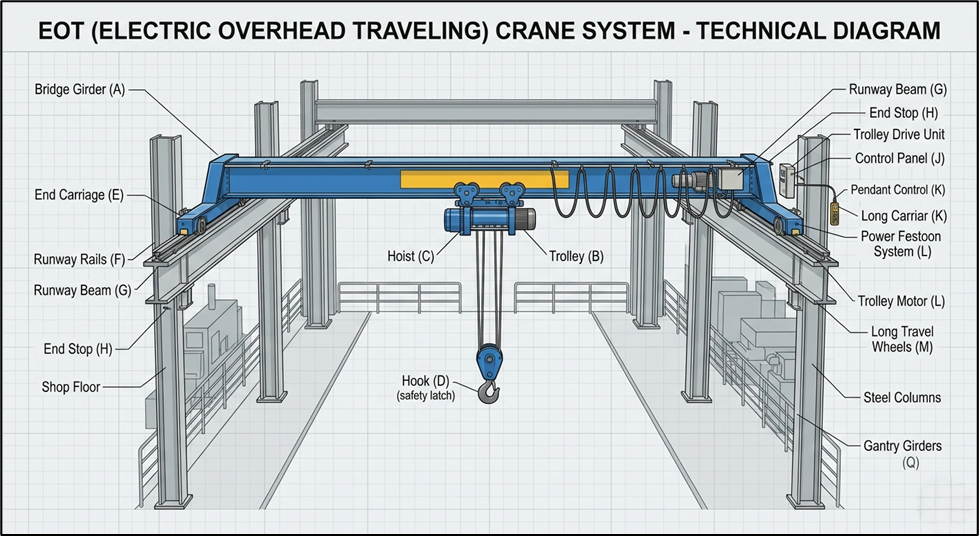
Full crane system showing bridge, hoist, trolley, hook, and movement directions
Understanding how individual EOT crane parts function together as an integrated system is what enables engineers and operators to manage crane performance, diagnose faults, and optimize operations effectively. The working of an EOT crane involves coordination between multiple systems:
- The operator gives a command through the crane control panel, pendant push button station, or radio remote control system
- The PLC-based or relay-based electrical control system processes the input and activates the appropriate motor circuit
- The hoist motor engages, releasing the crane brake to lift the load vertically via the wire rope and hook block
- The trolley moves the load horizontally along the bridge girder for accurate positioning
- The bridge drive motors move the entire crane system forward and backward along the runway rails
- Limit switches continuously monitor all travel positions and automatically cut power before any mechanical over-travel occurs
All these components work together to ensure smooth, safe, and precise material handling in every crane operating cycle.
Every EOT crane operating cycle depends on the seamless coordination of structural, mechanical, electrical, and crane control equipment systems. A fault in any single component — from a worn limit switch to a faulty pendant push button station — can disrupt the entire crane cycle and create safety risks.
Key Components Explained
Bridge (Girder)
The bridge — also called the girder — is the primary structural element of the EOT crane. It spans horizontally across the full width of the workspace, supported at both ends by the end carriages running on the elevated runway rails. The bridge carries the trolley and hoist system and transfers all lifted loads to the crane’s structural framework.
EOT cranes are built with either single girder or double girder bridge configurations. Single girder EOT cranes are suitable for light to medium duty lifting applications up to approximately 15–20 tonnes. Double girder EOT cranes are designed for heavy-duty, high-capacity applications — typically used in steel plants, foundries, and heavy engineering facilities handling loads from 15 tonnes up to several hundred tonnes.
- Single girder EOT cranes: lower cost, lighter structure, suitable for light to medium duty applications
- Double girder EOT cranes: higher capacity, longer spans, ideal for heavy industrial lifting
- Bridge girder material: structural steel manufactured and tested to relevant IS and international standards
Hoist System
The hoist is the core lifting mechanism of the EOT crane, responsible for all vertical load movement — lifting, holding, and controlled lowering. The hoist system consists of the hoist motor, gear reducer, wire rope drum, wire rope or lifting chain, hook block, and crane brake assembly working together as one integrated unit.
The hoist motor drives the gear reducer which rotates the wire rope drum — winding or unwinding the wire rope to raise or lower the hook block. The crane brake — a DC electromagnetic brake or AC thruster brake — holds the load securely when the hoist motor is de-energized, operating on a fail-safe spring-applied principle that automatically holds the load on any power loss.
- Hoist motor types: standard squirrel cage induction motor or VFD-controlled motor for smooth variable speed control
- Wire rope: multi-strand galvanized steel wire rope specified by diameter, construction, and breaking strength
- Hook block: forged steel hook with mandatory safety latch and swivel bearing
- Crane brake: DC electromagnetic brake or AC thruster brake for fail-safe load holding
Safety Note: The wire rope and hook block are the most safety-critical components in any EOT crane hoist system. Regular inspection for broken wires, deformation, and safety latch condition is mandatory for safe crane operation.
Trolley
The trolley is the carriage assembly that carries the hoist system and travels horizontally along the bridge girder. It provides horizontal movement of the load across the full width of the crane’s working envelope. The trolley consists of a structural frame, travel wheels, a trolley drive motor with gear reducer, and the mounting points for the hoist unit.
In modern PLC-controlled EOT cranes, the trolley drive is increasingly managed by a Variable Frequency Drive for smooth, stepless speed control — eliminating mechanical shock and enabling precise load positioning across the full bridge span.
End Carriages
End carriages are the structural assemblies mounted at each end of the bridge girder, connecting the bridge to the runway rail system. They carry the entire weight of the crane bridge, trolley, hoist, and lifted load. Each end carriage contains travel wheels and a bridge drive motor assembly that propels the crane along the runway rails. Regular inspection of end carriage wheel flanges, wheel treads, and drive components is essential for smooth, safe crane travel.
Crane Hook and Wire Rope
The crane hook is the load attachment point — the final link between the crane hoist system and the load being lifted. All crane hooks used in EOT applications are manufactured from forged high-strength steel and must comply with relevant safety standards for rated Working Load Limit (WLL). Safety latches are mandatory on all crane hooks to prevent accidental load disengagement during operation.
The wire rope transmits the hoist lifting force from the drum to the hook block. Wire rope selection requires careful consideration of rope construction, breaking strength, reeving arrangement, and crane duty class. Regular inspection for broken wires, kinking, corrosion, and diameter reduction is mandatory — all of which are criteria for immediate rope replacement.
Crane Control Panel
The crane control panel is the electrical intelligence of the EOT crane system. It receives operator commands from the pendant push button station, joystick controller, or radio remote control transmitter, processes these inputs, and activates the appropriate motor circuits, contactors, and protection devices to execute crane movements safely and precisely.
Traditional EOT crane control panels use relay and contactor-based control logic — a proven, reliable approach widely used in standard industrial crane applications. Modern PLC-based crane control panels replace relay logic with programmable logic controllers, enabling advanced features including variable speed control, anti-collision integration, load monitoring, fault logging, remote diagnostics, and IoT connectivity for real-time crane performance monitoring.
- Relay-based crane control panels: reliable and cost-effective for standard EOT crane applications
- PLC-based crane control panels: advanced automation, built-in diagnostics, and remote monitoring capability
- VFD integration: smooth motor speed control, reduced mechanical stress, and energy efficiency
- Overload and phase failure protection: automatic crane shutdown to protect motors and control circuits
Speed-O-Controls designs and manufactures both relay-based and advanced PLC-based crane control panels for EOT cranes across all duty classes — from standard manufacturing plant cranes to heavy-duty steel plant applications and hazardous zone flameproof crane control installations.
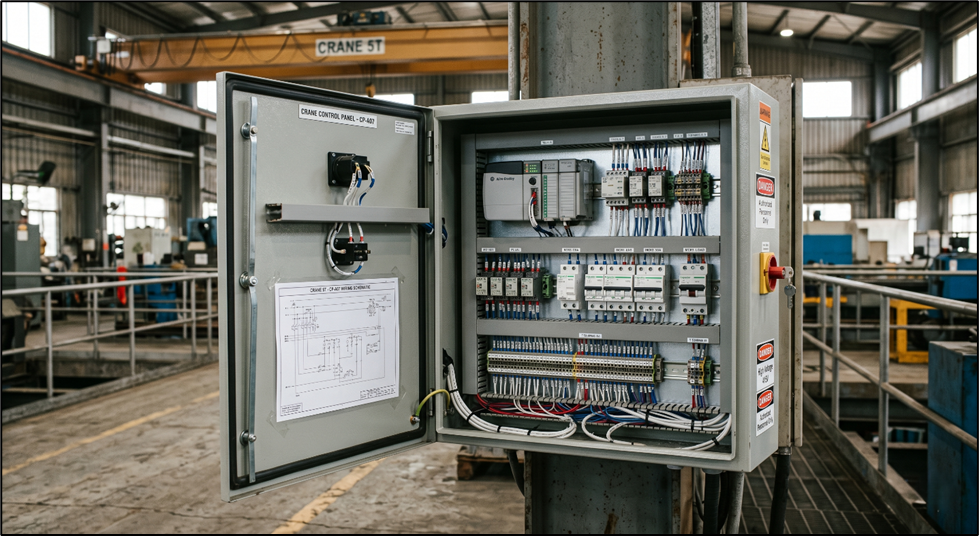
Industrial panel showing internal components and wiring
Radio Remote Control System
Radio remote control systems for EOT cranes provide operators with the freedom to control crane movements from any position within the operating area — without the physical constraints of a pendant cable or the isolation of a crane cabin. This operational flexibility delivers significant safety and efficiency advantages, particularly where operators need to move freely alongside the load and maintain the best possible view of the lift and landing area.
Modern radio remote control systems use dedicated industrial radio frequencies with encrypted digital transmission protocols — ensuring reliable, interference-free crane control even in electromagnetically demanding environments such as steel plants, induction furnace shops, and welding areas. Transmitters are ergonomically designed for comfortable extended-shift use, with clearly labeled buttons for all crane functions and a large, accessible emergency stop button.
- Dedicated industrial frequency bands for reliable, interference-resistant crane control
- Digital encryption: secure transmission preventing signal cross-talk between multiple cranes
- IP65-rated transmitters: robust protection against dust, moisture, and industrial contamination
- Flameproof radio remote control: certified for hazardous zone crane applications
- Battery management: rechargeable systems with low-battery warning indicators
Speed-O-Controls supplies a complete range of radio remote control systems for EOT cranes — standard industrial, IP65-rated, and flameproof certified versions — engineered for all industrial environments and crane duty classes.
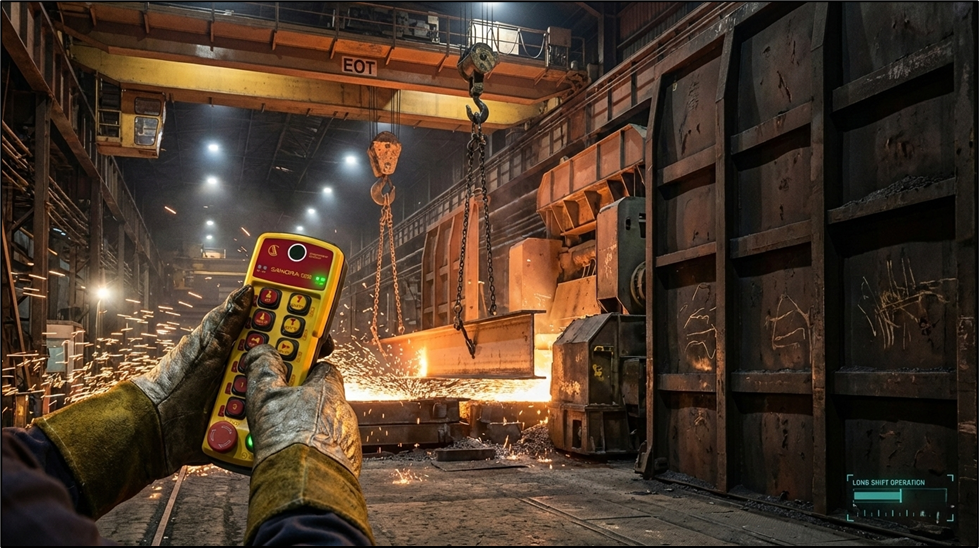
Worker controlling crane using handheld remote
Limit Switches
Limit switches are the primary safety devices that prevent EOT crane components from exceeding their designed travel limits — protecting both the crane structure and personnel working in the operating area. Every EOT crane is fitted with limit switches on the hoist (upper and lower travel limits), trolley (left and right travel limits), and bridge (forward and reverse travel limits).
EOT crane limit switches are available in several configurations: Rotary Limit Switches driven by the crane travel mechanism, lever-operated limit switches for direct mechanical actuation, and roller-type limit switches for high-cycle applications. In heavy-duty applications, multi-turn rotary limit switches with adjustable cam profiles provide precise, independently settable travel limits for each crane motion direction.
- Rotary limit switches: gear-driven cam operation for hoist, trolley, and bridge travel protection
- Upper hoist limit switch: prevents hook block collision with trolley frame — mandatory on all EOT cranes
- Lower hoist limit switch: prevents complete wire rope unwinding from drum
- Travel limit switches: prevent end-of-travel overrun and structural impact on trolley and bridge
Safety Requirement: Upper hoist limit switches are mandatory on every EOT crane. Failure or bypass can result in the hook block striking the trolley frame — causing catastrophic structural damage. Regular testing of all limit switches is a non-negotiable crane safety requirement.
Speed-O-Controls manufactures a comprehensive range of crane limit switches — including rotary, lever-type, and roller limit switches — engineered for reliable operation in steel plants, foundries, ports, and all heavy industrial crane applications.
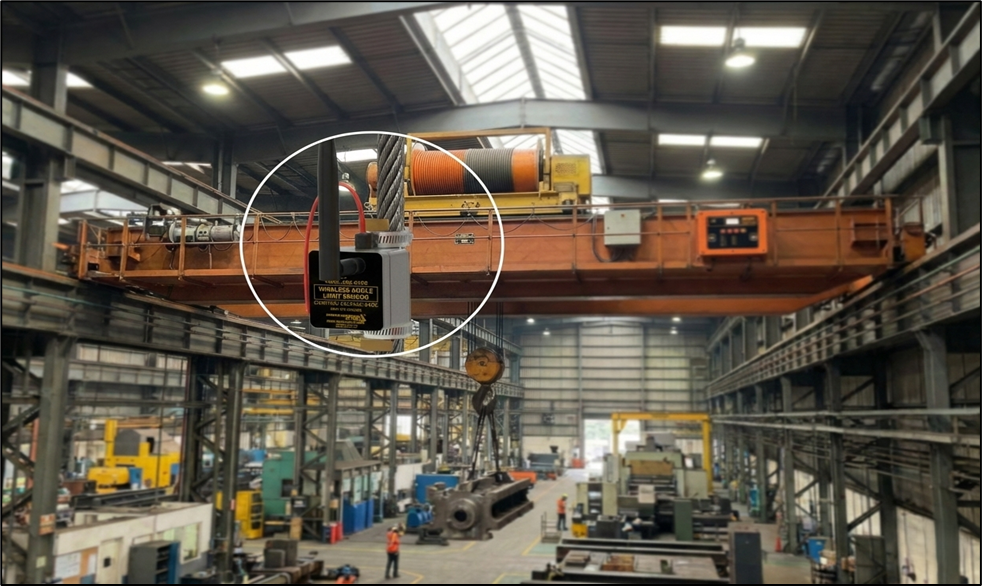
Angle limit sensor ensuring safe crane operation.
Festoon System
The festoon system supplies continuous electrical power and control signals to the moving components of the EOT crane — the trolley, hoist, and associated crane control equipment — throughout the full range of crane travel. Festoon cable systems use flexible, festoon-rated cables suspended from cable carriers on a support rail, creating a looping arrangement that extends and collapses as the crane travels.
For applications requiring higher current capacity, longer spans, or greater environmental protection, insulated conductor bar systems — also known as Safeline busbars — provide a fixed, continuous electrical supply through spring-loaded current collectors maintaining contact throughout crane travel.
- Festoon cable systems: flexible cable arrangement for trolley and hoist power supply on standard EOT cranes
- C-Track festoon systems: enclosed cable carrier systems for clean, protected cable management in harsh environments
- Insulated conductor bars (Safeline busbars): continuous current supply for high-speed or high-current crane applications
Speed-O-Controls supplies both festoon cable systems and insulated conductor bar systems for EOT crane power distribution — engineered for reliable, low-maintenance operation across all crane duty classes and industrial environments.
Applications of EOT Cranes
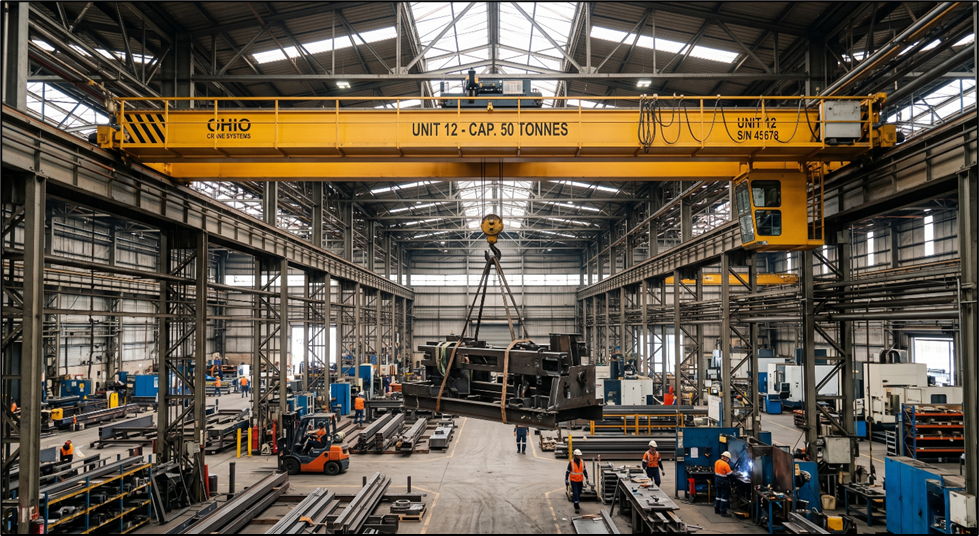
Crane lifting heavy material in real industrial setup.
EOT cranes serve as the backbone of material handling operations across virtually every major industrial sector. The specific combination of crane control equipment, safety systems, and structural components varies significantly based on the application requirements.
EOT cranes are widely used in:
- Manufacturing industries — assembly lines, precision component handling, and work-in-progress material movement
- Warehousing and logistics — high-cycle storage, retrieval operations, and load marshaling
- Steel plants — ladle cranes, charging cranes, and scrap handling under extreme heat and heavy-duty conditions
- Construction sites — structural steel erection, precast concrete handling, and heavy equipment positioning
- Heavy engineering industries — large component fabrication, machinery assembly, and shipbuilding
- Foundries and forging units — molten metal handling requiring flameproof crane control equipment
- Ports and shipyards — container handling and ship-to-shore lifting operations
- Chemical and process industries — hazardous zone crane operations requiring Ex-rated crane control gear
Key Benefits of EOT Crane Systems
1. Improved Safety
EOT crane systems are designed with advanced safety features including limit switches, overload protection electronics, anti-collision devices, and reliable crane control panels. These systems significantly reduce human error and minimize the risk of accidents in industrial environments. Modern PLC-based crane control systems with integrated safety circuits provide consistent, fail-safe protection regardless of operator experience or shift duration.
Facilities with properly maintained EOT crane systems and functional safety equipment — including correctly calibrated limit switches and overload protection — report significantly lower crane-related incident rates compared to operations with aging or inadequately maintained crane control gear.
2. Higher Efficiency
EOT cranes enable fast and smooth material handling across the full workspace. With PLC-based crane control panels, VFD-controlled drive systems, and radio remote control operation, industries can complete lifting tasks faster and with greater precision. Smooth, stepless speed control reduces load positioning time, and radio remote control allows operators to position themselves optimally for fast, accurate load placement.
Many industrial facilities report significant improvements in operational speed, material flow, and overall workflow efficiency after upgrading to modern EOT crane control equipment.
3. Reduced Downtime
Reliable EOT crane components and robust crane control equipment design ensure consistent crane performance across demanding industrial duty cycles. A structured preventive maintenance program combined with quality crane control gear — correctly rated limit switches, properly adjusted crane brakes, and well-maintained pendant push button stations — prevents unexpected breakdowns and minimizes unplanned production stoppages.
- Fewer operational interruptions from quality crane control components rated for actual duty class
- Faster fault diagnosis with PLC-based crane control panel diagnostic tools
- Extended service life through smooth VFD-controlled crane operation reducing mechanical stress
4. Precision Handling
EOT cranes provide accurate load positioning that is essential in industries where precision matters. VFD-controlled hoisting and travel drives, anti-sway control, and precise load monitoring electronics deliver the positioning accuracy required in manufacturing, assembly, and precision engineering applications. Controlled crane movements reduce material damage and improve work quality consistently across all shifts.
This level of precision in EOT crane load handling is especially important in automobile manufacturing, precision component fabrication, and heavy engineering applications where even minor positioning errors can cause costly product damage or production delays.
5. Better Productivity
By reducing manual effort, improving material handling speed, and enabling precise load positioning, EOT crane systems contribute directly to higher productivity in industrial operations. Modern crane control equipment — including radio remote control, PLC-based automation, and VFD drives — maximizes crane utilization and minimizes cycle times across all production shifts.
- Faster material movement across the full facility working area
- Reduced labor dependency through efficient crane control equipment
- Improved workflow management with reliable, high-availability crane systems
FAQs
1. What are the main parts of an EOT crane?
An EOT crane consists of key components including the Bridge (Girder), Hoist System, Trolley, End Carriages, Crane Hook and Wire Rope, Crane Control Panel, Pendant Push Button Station, Radio Remote Control System, Limit Switches, Festoon System, and Crane Brakes. Each component plays a specific, essential role in safe and efficient EOT crane operation.
2. What is the function of a hoist in an EOT crane?
The hoist is the vertical lifting mechanism of the EOT crane. It consists of a motor, gear reducer, wire rope drum, wire rope, and hook block — working together to lift, hold, and lower the attached load under complete operator control. The hoist brake — a DC electromagnetic brake or AC thruster brake — holds the load securely whenever the hoist motor is de-energized, providing fail-safe load retention on any power interruption.
3. Why are limit switches important in EOT crane safety?
Limit switches are the primary mechanical safety devices preventing EOT crane components from traveling beyond their designed operating limits. The upper hoist limit switch is particularly critical — it prevents the hook block from striking the trolley frame during lifting, which could cause catastrophic structural failure and load drop. All EOT crane travel motions must be protected by correctly adjusted, regularly tested limit switches at all times. Speed-O-Controls manufactures a complete range of crane limit switches for all EOT crane applications.
4. Can EOT cranes be upgraded with modern crane control equipment?
Yes — most existing EOT cranes can be upgraded with modern crane control equipment without full crane replacement. Upgrades include PLC-based crane control panels replacing aging relay systems, VFD-controlled drive systems for smooth speed control, radio remote control systems, anti-collision devices, load monitoring electronics, and new limit switches and crane brakes. Speed-O-Controls provides comprehensive crane revamping services tailored to each facility’s requirements.
5. What is the role of a crane control panel in EOT crane operation?
The crane control panel is the electrical intelligence of the EOT crane system — receiving operator commands, processing inputs, and activating the correct motor circuits and protection devices to execute crane movements safely. Modern PLC-based crane control panels from Speed-O-Controls offer advanced features including built-in fault diagnostics, VFD integration, anti-collision control, overload protection, remote monitoring, and IoT connectivity for real-time crane performance management.
Key Takeaways
- An EOT crane is a complete industrial system — every component, from the bridge girder and hoist to the crane control panel and limit switches, plays a critical role in safe and efficient operation
- Crane control equipment — including the crane control panel, pendant push button station, and radio remote control system — is the intelligence of the EOT crane and directly determines operational performance and safety
- Limit switches are mandatory safety devices on every EOT crane — regular functional testing is a non-negotiable crane safety requirement
- PLC-based crane control panels and VFD-controlled drive systems deliver superior performance, diagnostics, and energy efficiency compared to traditional relay-based crane control
- Radio remote control systems improve operator safety by enabling crane control from the optimal ground-level position, away from suspended loads
- Regular preventive maintenance of all EOT crane parts — wire rope inspection, brake adjustment, limit switch testing, and crane control panel inspection — is essential for long-term crane safety and reliability
- Existing EOT cranes can be significantly improved through targeted crane revamping — upgrading crane control equipment and safety systems without full crane replacement
Conclusion
EOT cranes are a combination of mechanical strength and advanced crane control systems. Each component — from the structural bridge girder and hoist wire rope to the crane control panel, pendant push button stations, limit switches, and radio remote control systems — plays a vital role in ensuring safe and efficient material handling across industrial facilities.
Understanding these EOT crane parts helps industries make better decisions about component specification, crane control equipment selection, preventive maintenance, and crane revamping strategies. A well-maintained EOT crane system — built with correctly rated crane control gear from an experienced manufacturer — delivers reliable industrial service for decades.
Whether you are specifying a new EOT crane installation, evaluating crane control equipment suppliers, or planning a crane revamping project, the foundation is always the same: understand the components, understand their interactions, and invest in the quality and maintenance that safe, productive crane operations demand.
Speed-O-Controls — over 40 years of expertise manufacturing and supplying premium EOT crane parts and crane control equipment across India and global markets. Pendant push button stations, limit switches, radio remote control systems, PLC-based crane control panels, conductor bars, crane brakes — your complete crane control solutions partner.
📧 sales@socgroup.in | 📞 +91-22-42469700 | 🌐 www.speedocontrols.com