
In today’s rapidly evolving industrial landscape, the choice between manual and automated crane control systems is one of the most critical decisions facility managers, plant engineers, and operations leaders face. Both systems have fundamentally shaped the way industries manage heavy lifting and material handling — but as crane control technology advances, the differences between them are becoming increasingly significant.
Manual crane control has been the backbone of industrial operations for decades. Trained operators using pendant push button stations, joystick controllers, and master controllers have traditionally driven safe and efficient crane movements. However, with rising demands for productivity, tighter safety regulations, and the growing adoption of Industry 4.0 technologies, automated crane control equipment is transforming operations across steel plants, ports, foundries, and manufacturing facilities worldwide.
This comprehensive guide examines the key differences between manual and automated crane control systems across every critical parameter — safety, efficiency, cost, precision, flexibility, maintenance, and more. Whether you are a plant manager considering an upgrade to your EOT crane parts and control gear, or an engineer evaluating control panel solutions, this comparison will help you make a well-informed decision.
The question is not simply which system is “better” — it is about which crane control system is better for your specific operation, scale, industry, and long-term performance goals.
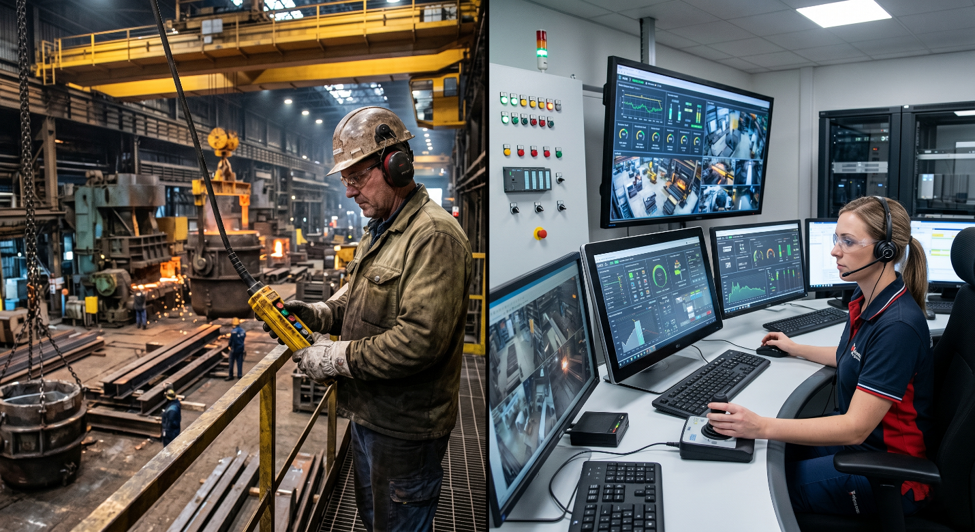
Split-screen photo of a crane operator using pendant controls on left and automated HMI crane control room on right, realistic industrial setting.
What Are Manual Crane Control Systems?
Manual crane control systems are the traditional approach to EOT crane operation, where a trained human operator directly controls every crane movement using dedicated crane control equipment. Operators use pendant push button stations, joystick controllers, master controllers, or cabin-mounted lever controls to manage all lifting, lowering, traversing, and load positioning tasks.
Manual systems have served heavy industries for well over a century. Their mechanical simplicity, straightforward maintenance, and relatively low upfront investment have made them the default choice for many operations — particularly in smaller facilities or environments where task requirements change frequently.
Core crane control equipment used in manual systems:
- Pendant push button stations for directional movement control from ground level
- Joystick controllers and master controllers for cabin-based crane operation
- Radio remote control systems for wireless, portable crane operation
- Rotary limit switches and lever-operated limit switches for end-of-travel protection
- DC electromagnetic brakes and AC solenoid brakes for controlled stopping
- Resistance boxes (DBR) and Fechral edge wound resistors for motor speed control
- Traditional control panels with contactors and relay-based electrical circuits
Industries where manual crane control remains widely used:
- Small-scale fabrication and welding workshops with low-frequency lifting
- Custom construction projects requiring variable, task-specific crane movements
- Foundries and forging units with irregular material handling requirements
- Facilities with limited budgets for crane control equipment upgrades
In simple terms: In a manual crane control system, performance depends entirely on the skill, experience, and attentiveness of the operator handling the pendant push button station or joystick controller.
What Are Automated Crane Control Systems?
Automated crane control systems use advanced crane control equipment — including Programmable Logic Controllers (PLCs), smart sensors, IoT connectivity, and intelligent software — to manage crane operations with minimal or zero direct human input. These systems monitor, process, and execute precise crane movements automatically, based on pre-programmed sequences and real-time sensor data.
Modern automated crane systems go far beyond basic mechanization. They incorporate anti-collision devices, automated load monitoring through load cells and electronics, variable frequency drives (VFDs) for smooth motor control, and remote monitoring via cloud-connected HMI panels — creating a smarter, safer, and more efficient crane control ecosystem.
Key crane control equipment and technologies in automated systems:
- PLC-based control panels — the intelligent core of automated crane operations
- Smart sensors for real-time load weight, speed, position, and temperature monitoring
- Laser anti-collision devices and infrared anti-collision systems to prevent crane crashes
- Automated positioning systems with encoder-based feedback for precise load placement
- Load cells and electronics for continuous overload protection and weight monitoring
- Radio remote control systems for wireless crane management across large facilities
- Insulated conductor bars (Safeline busbars) and C-Track festoon systems for reliable power delivery to moving cranes
- IoT-enabled HMI panels and cloud platforms for real-time performance analytics and predictive maintenance
- Variable Frequency Drives (VFDs) for smooth, energy-efficient crane motor control
In simple terms: Automated crane control systems integrate advanced crane control gear and electronics to think, monitor, and act — delivering consistent, repeatable performance around the clock with minimal operator dependency.
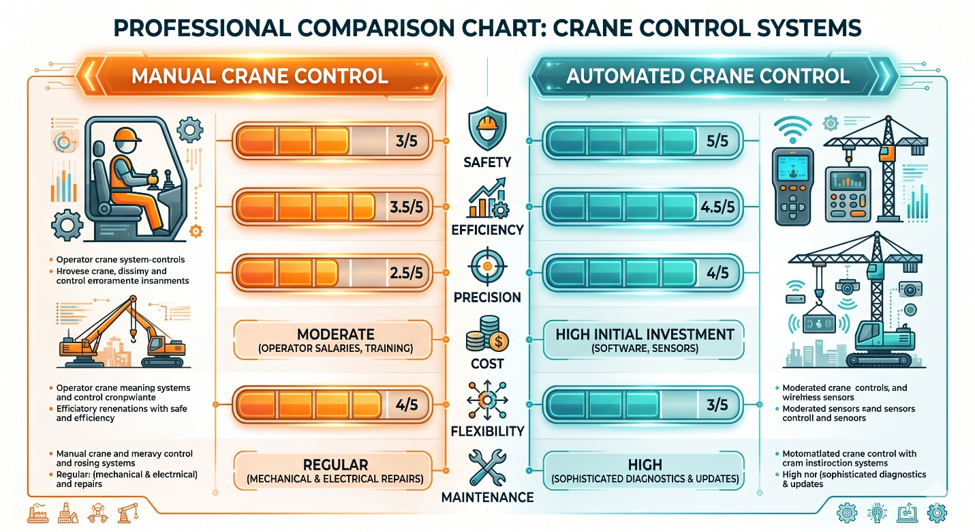
Professional comparison chart of Manual vs Automated Crane Control with icons for Safety, Efficiency, Cost and Precision, clean white background.
Manual vs Automated Crane Control Systems: A Detailed Comparison
1. Safety Performance
Safety is the most critical factor in any crane control system evaluation. Manual crane systems are fundamentally dependent on the operator’s attentiveness, physical condition, and experience with crane control equipment. Fatigue, distraction, misjudgment, and communication errors are consistently identified as leading contributors to crane-related workplace accidents.
Automated crane control systems tackle these risks directly. Built-in crane safety equipment — including laser anti-collision devices, infrared anti-collision systems, automatic overload protection via load cells, emergency stop circuits, and angle limit sensors — significantly reduce accident risk regardless of operational duration or workload intensity.
According to industry safety data, automated crane control systems equipped with anti-collision devices and load monitoring electronics can reduce workplace incidents by 25–30% compared to manually operated crane systems, particularly in high-risk environments such as steel plants, foundries, and chemical industries.
Additionally, automated systems log every crane movement, load event, and system alert — creating detailed safety audit trails that support compliance with occupational health and safety regulations and facilitate proactive risk management.
2. Operational Efficiency & Productivity
Manual crane operators face inherent human limitations — fatigue builds over long shifts, concentration wavers under repetitive task loads, and the speed of crane operation is limited by what an operator can physically process and react to. Shift changes also introduce downtime and handover gaps that impact overall facility throughput.
Automated crane control systems face none of these limitations. PLC-based control panels execute pre-programmed crane movements at consistent speeds, completing repetitive material handling tasks faster and with fewer interruptions. In facilities running continuous production cycles — such as steel plants, automobile plants, and port operations — this translates directly into measurable productivity gains.
Facilities that have upgraded from manual to automated crane control equipment report efficiency improvements of 30–40% in material handling throughput. High-volume port operations using fully automated crane systems have reported container handling cycle improvements of up to 50%.
3. Precision & Load Accuracy
Even the most experienced crane operators face challenges achieving consistent millimeter-level load placement accuracy — particularly during extended shifts, in confined spaces, or under poor visibility conditions. Manual crane precision depends on operator skill, visibility, experience with the specific joystick controller or pendant push button station, and ambient conditions such as wind or vibration.
Automated positioning systems integrated into modern crane control panels eliminate these variables entirely. Using encoder-based feedback, laser sensors, and angle limit sensors, automated crane systems place loads with extraordinary precision — replicating the exact same movement to the same position consistently across thousands of crane cycles.
Anti-sway control technology, increasingly standard in automated crane control equipment, reduces load oscillation during crane travel — a significant operational challenge in manual crane operation that requires considerable operator skill and time to manage effectively.
Precise load control enabled by automated crane control gear is particularly critical in industries such as automobile manufacturing, precision engineering, and paper and pulp processing, where even minor placement errors can cause significant product damage or costly production delays.
4. Cost Analysis: Upfront Investment vs Long-Term ROI
Cost is frequently the primary consideration when evaluating crane control equipment upgrades. Manual crane control systems carry a clear advantage in initial capital expenditure — they require standard electrical panels, pendant push button stations, and joystick controllers, which are significantly less expensive than full PLC-based automation installations.
However, a purely upfront cost comparison does not capture the complete financial picture. The true cost of crane operations includes ongoing labor costs, accident-related expenses, increased maintenance resulting from human-error-induced mechanical wear on crane brakes and limit switches, and productivity losses from unplanned downtime. When these factors are properly accounted for, automated crane control systems frequently deliver a more favorable total cost of ownership.
Industry analysis consistently indicates that automated crane control systems recover their initial investment within 3 to 5 years through reduced labor dependency, lower accident-related costs, decreased crane brake and limit switch wear from smoother automated operation, and improved overall equipment effectiveness (OEE).
Full cost comparison — key factors:
- Manual systems: lower upfront crane control equipment cost but higher ongoing labor, training, and human-error-related expenses
- Automated systems: higher initial capital investment but strong long-term ROI through efficiency and safety gains
- Retrofitting existing EOT cranes with PLC panels, sensors, and anti-collision devices reduces full automation costs significantly
- Variable Frequency Drives (VFDs) in automated crane systems reduce energy consumption, contributing to ongoing operational cost savings
- Predictive maintenance enabled by IoT-connected crane control gear reduces unplanned downtime and reactive maintenance costs
5. Flexibility & Adaptability
Manual crane control systems have a natural advantage in operational flexibility. An experienced operator using a joystick controller or pendant push button station can assess a new task in real time, adapt to changing site conditions, and manage complex, non-routine lifts that would be challenging to pre-program into an automated control system. This makes manual crane control particularly valuable in construction environments, custom fabrication shops, mining operations, and anywhere task variation is the norm.
Automated crane control systems are engineered for consistency and high-volume repetition. They deliver peak performance in structured environments where tasks are predictable. However, modern PLC-based crane automation platforms are increasingly incorporating adaptive algorithms and AI-driven decision logic that allow them to handle a broader range of operational scenarios with reduced pre-programming requirements.
The approach many leading industrial facilities are adopting is a hybrid crane control strategy — automated PLC-based systems manage repetitive, high-volume lifting tasks, while operators retain manual control via joystick controllers or radio remote control systems for complex, non-routine lifts.
6. Maintenance & Equipment Reliability
Manual crane control systems are mechanically simpler, which can make routine maintenance of crane control gear — such as inspecting limit switches, checking pendant push button stations, and servicing crane brakes — more straightforward. However, human-error-induced mechanical stress — including overloading beyond the rated capacity, abrupt emergency stops, and jerky movement patterns — significantly increases wear on EOT crane parts such as DC electromagnetic brakes, rotary limit switches, and resistance boxes.
Automated crane control systems, while more technologically complex, are engineered to operate within precise load and movement parameters at all times. This controlled operation reduces mechanical stress on crane brakes, limit switches, and structural crane components, extending their service life and reducing replacement frequency. IoT-connected crane control gear continuously monitors equipment health, enabling predictive maintenance that flags potential issues before they cause operational failures.
Predictive maintenance capabilities built into modern automated crane control systems can reduce unplanned operational downtime by 20–25%, generating significant cost savings and improving production continuity in steel plants, automobile factories, and port operations.
7. The Evolving Role of the Crane Operator
A common and important misconception is that crane automation eliminates the need for crane operators entirely. In practice, automation fundamentally redefines the operator’s role rather than replacing it. In automated crane environments, operators transition from directly managing crane movements via pendant push button stations to supervising system performance, managing exceptions, conducting quality checks, and handling non-routine lifts.
This transition demands a higher level of technical competency from operators — they need to understand PLC-based crane control panel operations, interpret real-time data from IoT dashboards, respond appropriately to anti-collision device alerts, and manage system overrides effectively. Many industrial facilities invest in upskilling their existing crane operators to manage automated crane control systems, creating a more technically capable and versatile workforce.
- Skilled operators supervise multiple automated cranes simultaneously from centralized HMI control stations
- Technical proficiency in PLC operation, crane control panel management, and sensor data interpretation becomes essential
- Emergency manual override using radio remote control systems or pendant push button stations remains a critical operator responsibility
- Physical risk and operator fatigue are dramatically reduced as direct crane cabin operation is replaced by remote system monitoring
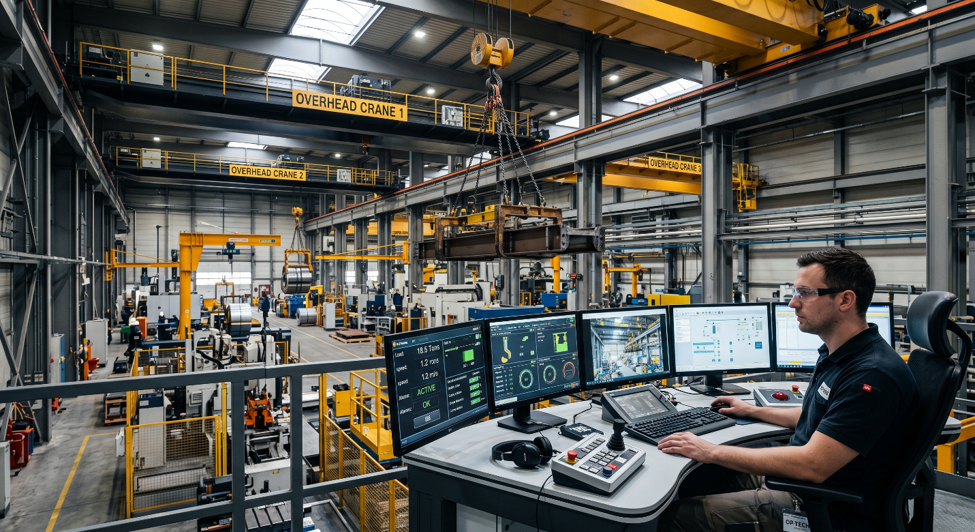
Technician monitoring automated EOT cranes from an HMI workstation inside a modern industrial plant.
When Should You Choose Manual Crane Control Equipment?
Despite the growing advantages of automated crane control systems, manual crane operation remains the appropriate and cost-effective choice in several specific scenarios. Understanding when manual crane control equipment is the better fit prevents unnecessary capital expenditure and ensures the control system truly matches operational requirements.
- Small-scale or low-frequency lifting operations where automated crane control equipment investment would not deliver sufficient return on investment
- Environments with highly variable, non-repetitive crane tasks that require real-time human judgment from an experienced operator
- Job sites such as construction projects and mining operations where crane task requirements change daily
- Facilities with limited budgets where investment in full PLC-based crane automation is not currently feasible
- Operations in unstructured or outdoor environments — such as open-air construction sites — where sensor-based automation systems may face reliability challenges
- Interim operations while a facility plans and implements a phased crane control equipment upgrade strategy
When Should You Choose Automated Crane Control Systems?
Automated crane control equipment delivers its greatest value in specific operational environments. If your facility matches one or more of the following criteria, automation is very likely the right strategic investment for your crane operations.
- High-volume, repetitive EOT crane lifting tasks in steel plants, automobile factories, or warehousing facilities where consistency and speed are critical
- Safety-critical environments such as chemical industries, foundries, and flameproof zones where human error carries severe consequences
- 24/7 production operations that require continuous crane productivity without manpower constraints or shift-change downtime
- Industries with strict load precision requirements where automated load cells, positioning systems, and angle limit sensors are essential
- Large-scale facilities such as ports and shipyards where throughput speed directly impacts revenue and vessel turnaround performance
- Operations focused on reducing long-term crane control equipment costs and improving overall equipment effectiveness (OEE) through predictive maintenance
The Rise of Hybrid Crane Control Systems
As industrial operations continue to evolve, hybrid crane control systems are emerging as the preferred solution for many facilities seeking the benefits of both approaches. Rather than choosing entirely between traditional crane control gear and full PLC-based automation, hybrid systems allow operators to retain direct manual control — via joystick controllers, pendant push button stations, or radio remote control systems — for complex and non-routine lifts, while automation manages high-frequency, repetitive crane movements.
Modern hybrid crane control platforms are built on flexible PLC-based control panels that support seamless switching between manual and automated operating modes. This architecture gives facility managers the ability to scale crane automation gradually — minimizing disruption to ongoing production while progressively improving efficiency, precision, and safety performance.
Key advantages of hybrid crane control systems:
- Combines the precision and consistency of PLC-based automated crane control with the adaptability and judgment of experienced operators
- Enables a phased, lower-risk transition to full crane automation without major production disruption
- Reduces capital investment risk by allowing incremental upgrades to existing crane control equipment
- Maintains operator engagement and skill development alongside automation adoption
- Ideal for facilities operating both highly repetitive production crane cycles and complex, variable material handling tasks
Speed-O-Controls designs and supplies a comprehensive range of crane control gear — including PLC-compatible control panels, joystick controllers, pendant push button stations, anti-collision devices, and load cells — that support both manual and hybrid automated crane control configurations across industries in India and globally.
Industry-Wise Crane Control System Recommendation Guide
Different industries have fundamentally different crane control equipment requirements. Here is a practical recommendation guide based on industry type, operation scale, and the specific crane control gear best suited to each environment.
Steel Plants & Heavy Industries
Recommended approach: Fully automated crane control systems with PLC-based control panels, load cells, laser anti-collision devices, and DC electromagnetic brakes for high-load, high-risk crane operations. Steel plant environments involve extreme heat, heavy loads, and hazardous conditions that make manual crane operation particularly dangerous. Automation — combined with flameproof crane control equipment where required — removes operators from direct risk exposure while ensuring precise, consistent crane performance.
Automobile & Manufacturing Plants
Recommended approach: Automated or hybrid crane control systems for assembly line material handling; manual crane control with joystick controllers or pendant push button stations for custom fabrication areas. Manufacturing environments with repetitive production cycles benefit significantly from automated crane control gear, particularly for feeding assembly lines and managing work-in-progress inventory at consistent speed and precision.
Foundries & Forging Units
Recommended approach: Flameproof crane control equipment for hazardous zone compliance, combined with automated load monitoring via load cells and electronics. Foundry environments demand crane control gear that can withstand extreme temperatures and particulate exposure. Flameproof radio remote control systems, flameproof pendant push buttons, and flameproof limit switches ensure safe, compliant crane operation in these demanding settings.
Ports, Shipyards & Logistics
Recommended approach: Fully automated crane control systems for container handling at scale, supported by insulated conductor bars and cable reeling drum systems for reliable power distribution. Port operations involve highly repetitive, high-volume container movements that are ideally suited to full PLC-based automation. Leading ports globally have adopted automated crane control systems, achieving significant gains in container throughput and a measurable reduction in vessel turnaround time.
Mining & Power Plants
Recommended approach: Robust crane control equipment rated for outdoor and harsh-environment use, including IP65-rated control panels, flameproof limit switches, and radio remote control systems for safe remote crane operation. Mining operations and power plant environments demand crane control gear engineered for durability and reliability in extreme conditions, with radio remote control systems enabling operators to maintain safe working distances from heavy crane loads.
Chemical & Paper & Pulp Industries
Recommended approach: Flameproof and IP65-rated crane control equipment with automated overload protection via load cells and anti-collision devices for safe material handling in sensitive process environments. Chemical plant crane operations require strict compliance with hazardous zone safety standards, making flameproof crane control gear a regulatory and operational necessity.
FAQs
1. What is the difference between manual and automated crane control systems?
Manual crane control systems rely on trained operators using pendant push button stations, joystick controllers, or master controllers to directly manage every crane movement. Automated crane control systems use PLC-based control panels, smart sensors, anti-collision devices, and load monitoring electronics to execute crane movements automatically with minimal human input. Automated systems deliver superior consistency, safety, and efficiency — particularly in high-volume industrial operations.
2. Is manual crane operation becoming obsolete?
Not entirely. Manual crane control remains relevant in industries with complex, variable, and non-repetitive lifting tasks that require real-time human judgment. However, in high-volume, safety-critical, and precision-demanding crane operations — such as those in steel plants, automobile factories, and port logistics — automated and hybrid crane control systems are rapidly becoming the industry standard. The overall trend in industrial crane control equipment is clearly toward greater automation, driven by technological advances and declining automation costs.
3. Can existing EOT cranes be upgraded with automated crane control equipment?
Yes — retrofitting is one of the most cost-effective paths to crane automation. Most conventional EOT cranes and overhead cranes can be upgraded with PLC-based control panels, radio remote control systems, load cells, rotary limit switches, anti-collision devices, and IoT-connected monitoring systems — without full crane replacement. Speed-O-Controls specializes in crane revamping and control equipment upgrades that bring existing cranes up to modern automation and safety standards.
4. What crane control equipment is essential for automated crane systems?
Core crane control equipment for automated systems includes: PLC-based control panels, load cells and electronics for overload protection, laser or infrared anti-collision devices, rotary limit switches and angle limit sensors for precise travel control, variable frequency drives (VFDs) for smooth motor operation, insulated conductor bars or C-Track festoon systems for reliable power delivery, and IoT-enabled HMI panels for remote monitoring and predictive maintenance.
5. What is the ROI of upgrading to automated crane control systems?
While automated crane control equipment requires a higher initial investment than manual crane control gear, the return on investment is driven by measurable long-term savings: reduced labor costs, fewer accident-related expenses, lower downtime from predictive maintenance enabled by IoT-connected crane control systems, and significant improvements in crane throughput. Most industrial facilities report recovering their crane automation investment within three to five years, after which the systems continue to generate ongoing operational cost savings.
6. Which crane control systems are best for hazardous and flameproof environments?
In hazardous environments — including chemical plants, paint shops, gas processing facilities, and certain mining operations — crane control equipment must comply with flameproof (Ex-rated) safety standards. Essential flameproof crane control gear includes flameproof radio remote control systems, flameproof limit switches, flameproof pendant push button stations, and flameproof thruster brakes. Speed-O-Controls manufactures and supplies a certified range of flameproof crane control products engineered for safe, reliable operation in explosive atmosphere zones.
Key Takeaways
- Manual crane control equipment — including pendant push button stations, joystick controllers, and master controllers — offers operational flexibility and lower upfront cost but is fundamentally limited by operator performance, fatigue, and human error
- Automated crane control systems using PLC-based control panels, smart sensors, anti-collision devices, and load monitoring electronics deliver superior safety, precision, and efficiency for high-volume and safety-critical operations
- The right crane control system depends on your industry, EOT crane operation scale, task complexity, and long-term business performance goals
- Hybrid crane control strategies — combining automated PLC control with manual radio remote control or pendant push button operation — are increasingly adopted as the optimal solution for facilities with mixed lifting requirements
- Existing EOT cranes can be retrofitted and revamped with modern crane control equipment without full equipment replacement, making the transition to automation more accessible and cost-effective
- Crane operators in automated environments transition to higher-skilled supervisory roles managing PLC systems, monitoring IoT dashboards, and handling non-routine crane operations
- Total cost of ownership — not just initial crane control equipment investment — should guide crane control system decisions
- Automation is rapidly transitioning from a competitive advantage to an industry standard across steel plants, automobile industries, ports, foundries, and heavy industrial operations globally
Conclusion
The comparison between manual and automated crane control systems ultimately comes down to matching the right crane control equipment to your specific operational reality. Manual crane control systems — built on proven crane control gear such as pendant push button stations, joystick controllers, limit switches, and DC electromagnetic brakes — continue to deliver value in environments where flexibility, human judgment, and lower capital investment take priority.
For industries demanding precision load positioning, round-the-clock productivity, enhanced safety through anti-collision devices and load monitoring electronics, and scalable crane automation — automated and hybrid crane control systems represent the clear strategic path forward. As PLC-based crane control technology continues to advance and costs continue to decline, the case for crane automation grows stronger across every major industrial sector.
Whether your facility needs a full crane control system automation upgrade, a phased hybrid strategy, or expert guidance on retrofitting your existing EOT cranes with modern crane control equipment — the right solution begins with understanding your operational requirements and long-term performance goals.
Speed-O-Controls — trusted for over 40 years as a leading manufacturer and supplier of crane control equipment, EOT crane parts, and industrial control gear across India and global markets. Contact us for expert guidance on manual, automated, or hybrid crane control solutions tailored to your industry.
📧 sales@socgroup.in | 📞 +91-22-42469700 | 🌐 www.speedocontrols.com