
Introduction
Industrial crane remote control systems are transforming modern crane operations. Instead of operating from a fixed cabin, operators can control cranes wirelessly from a safe distance.
This improves safety, flexibility, and efficiency across industries like manufacturing, construction, logistics, and heavy industries.
In this guide, we explore detailed benefits, working, and real-world use cases of crane remote control systems.
What is Industrial Crane Remote Control?
Industrial crane remote control is an advanced wireless system that enables operators to control crane movements from a distance using a handheld transmitter, eliminating the need to operate from a fixed cabin. This technology is widely used in modern industries to improve safety, flexibility, and operational efficiency.
Instead of being physically present on the crane, the operator can stand at a safe and convenient location while managing all crane functions in real-time.
It includes:
• Transmitter (Remote Control Unit): A handheld device with buttons or joysticks used by the operator to send commands
• Receiver (Mounted on Crane): Installed on the crane to receive signals and pass them to the control system
• Control Interface/System: Processes the signals and executes crane movements such as hoisting, trolley motion, and bridge travel
In simple terms: It allows operators to control the crane safely and efficiently from a distance without sitting inside the cabin, improving both visibility and safety.
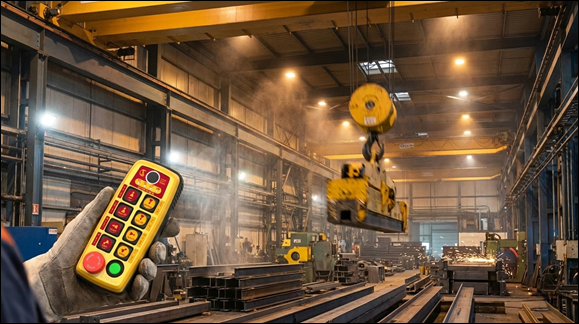
Worker controlling crane remotely from safe distance.
How Remote Control Crane Systems Work
Remote-controlled crane systems operate through an advanced wireless communication process that ensures smooth coordination between the operator’s input and the crane’s movement. These systems are designed to provide real-time response, high precision, and safe operation in industrial environments.
- The operator uses a handheld remote control equipped with buttons, switches, or joysticks to give specific commands such as lifting, lowering, or moving the crane
- These inputs are instantly converted into digital signals and transmitted wirelessly using radio frequency (RF) communication
- The receiver unit installed on the crane continuously receives these signals and verifies them for accuracy and safety
- The crane’s control system (such as PLC or control panel) processes the received signals and translates them into actionable commands
- Based on these commands, the crane executes precise movements like hoisting, trolley motion, or bridge travel with controlled speed and direction
- Safety mechanisms such as emergency stop, signal encryption, and fail-safe systems ensure that operations remain secure even in case of signal interruption
This entire process happens in real-time with minimal delay, allowing operators to control the crane smoothly and accurately while maintaining a safe distance from hazardous areas.
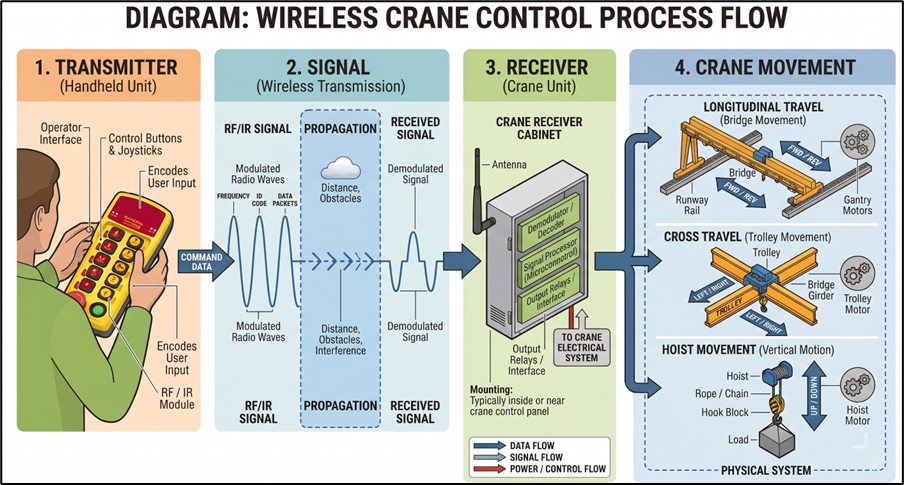
Remote → Signal → Receiver → Crane movement
Key Benefits of Industrial Crane Remote Control
1. Improved Safety:
Operators can stay away from hazardous zones such as heavy loads, moving machinery, or high-temperature environments.
This significantly reduces the chances of workplace accidents and injuries.
2. Better Visibility
Operators can stand at the best position to clearly see the load and surroundings.
This removes blind spots and improves accuracy.
3. Increased Efficiency
Operations become faster because operators can move freely and adjust position.
It reduces delays and improves workflow speed.
4. Reduced Operator Fatigue
No need to sit in crane cabins for long hours.
This improves comfort and productivity.
5. Flexibility in Operations
Operators can easily move around and handle different tasks.
This makes operations more dynamic and efficient.
6. Lower Maintenance Issues
Smooth operation reduces wear and tear on crane components.
👉 Overall, remote control systems improve safety, productivity, and operational efficiency.
Use Cases of Crane Remote Control
Crane remote control systems are widely used across multiple industries where material handling, safety, and precision are critical. These systems help improve operational efficiency while reducing risks associated with manual crane operation.
• Manufacturing Plants –
Remote-controlled cranes are used for handling raw materials, moving components between production stages, and transporting finished goods. Operators can manage operations more efficiently with better visibility and control, ensuring smooth workflow in assembly lines.
• Construction Sites –
On construction sites, remote control allows operators to stand closer to the load for better accuracy during lifting and placement. This is especially useful when working in complex environments where precision and safety are essential.
• Warehousing & Logistics –
In warehouses, cranes are used for loading, unloading, and organizing goods. Remote control systems help in faster material movement, reduce handling time, and improve overall storage efficiency.
• Ports & Shipping –
Remote-controlled cranes play a crucial role in container handling, stacking, and loading/unloading ships. Operators can work from safer positions while maintaining clear visibility of large containers, improving both speed and safety of operations.
• Steel & Heavy Industries –
In industries dealing with extremely heavy loads or high-temperature materials, remote control systems allow operators to stay at a safe distance. This reduces exposure to hazardous conditions while ensuring precise handling of materials.
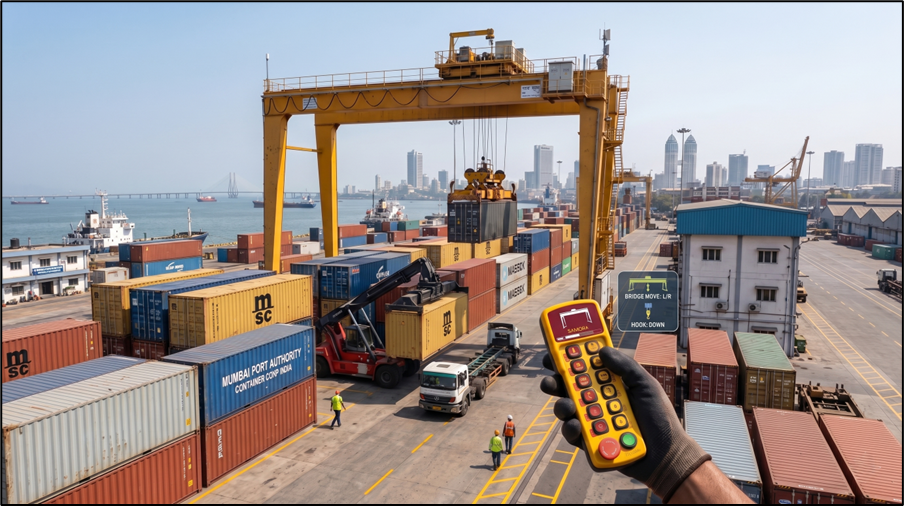
Industrial crane lifting heavy materials while operator controls it remotely from ground level.
Can Existing Cranes Be Upgraded?
Yes, most industrial cranes can be easily upgraded with remote control systems without the need for complete replacement. This makes it a practical and cost-effective solution for industries looking to improve safety, efficiency, and control without investing in entirely new equipment.
Modern retrofitting solutions are designed to integrate seamlessly with existing crane systems, ensuring minimal disruption to ongoing operations.
The upgrade process typically includes:
• Installing Receiver Unit – A wireless receiver is mounted on the crane to capture signals sent from the remote control transmitter and communicate them to the crane’s system
• Modifying Control Panel – The existing control panel is adjusted or integrated with new components so it can process remote commands along with manual inputs
• Adding Safety Features – Advanced safety mechanisms such as emergency stop buttons, signal encryption, overload protection, and fail-safe systems are implemented to ensure secure operations
• System Integration & Testing – After installation, the entire system is tested to ensure smooth communication, accurate response, and safe functionality
This approach allows businesses to modernize their crane operations at a significantly lower cost compared to purchasing new cranes, while still gaining the benefits of improved safety, efficiency, and flexibility.
FAQs
1. What is the role of a crane control panel?
The control panel manages all crane operations and ensures smooth and safe functioning.
It controls:
• Hoist
• Trolley
• Bridge movement
2. Is crane remote control safe?
Yes, modern systems include emergency stop, fail-safe mechanisms, and secure signals.
3. What is the operating range?
Typically between 50 to 300 meters depending on system quality.
4. Can one remote control multiple cranes?
Yes, advanced systems allow switching between multiple cranes.
5. Does it replace operators?
No, it reduces workload but still requires skilled operators.
6. Which industries benefit most?
Manufacturing, logistics, ports, and heavy industries benefit the most.
Conclusion
Industrial crane remote control is no longer a luxury—it is becoming a standard in modern operations. By improving safety, efficiency, and flexibility, these systems are helping industries move toward smarter and more productive workflows.
If you’re planning to upgrade your crane system with remote control technology, it can be a game-changing investment for long-term growth and operational excellence.