
Introduction
Crane controllers are the nerve centre of any EOT crane or overhead crane system. They manage every critical function — from lifting and lowering to traversing and precise load positioning. When crane control equipment malfunctions, the consequences extend far beyond a simple mechanical inconvenience. Unplanned crane downtime can halt entire production lines, delay material handling schedules, compromise workplace safety, and generate significant financial losses for industrial facilities.
Yet despite their critical importance, crane controller problems are frequently misdiagnosed, inadequately repaired, or ignored until they cause a serious operational failure. Understanding the most common crane controller faults — and knowing how to identify, troubleshoot, and fix them effectively — is essential knowledge for plant engineers, maintenance teams, and facility managers across steel plants, foundries, automobile factories, ports, and heavy industrial operations.
This comprehensive troubleshooting guide covers the most frequently encountered problems in crane control systems — including electrical faults, limit switch failures, brake malfunctions, joystick and pendant push button issues, PLC control panel faults, radio remote control problems, and Variable Frequency Drive faults — along with practical, expert-recommended solutions for each. Whether you manage a single workshop crane or an entire fleet of EOT cranes, this guide will help you minimise downtime, extend the service life of your crane control equipment, and keep your operations running safely and efficiently.
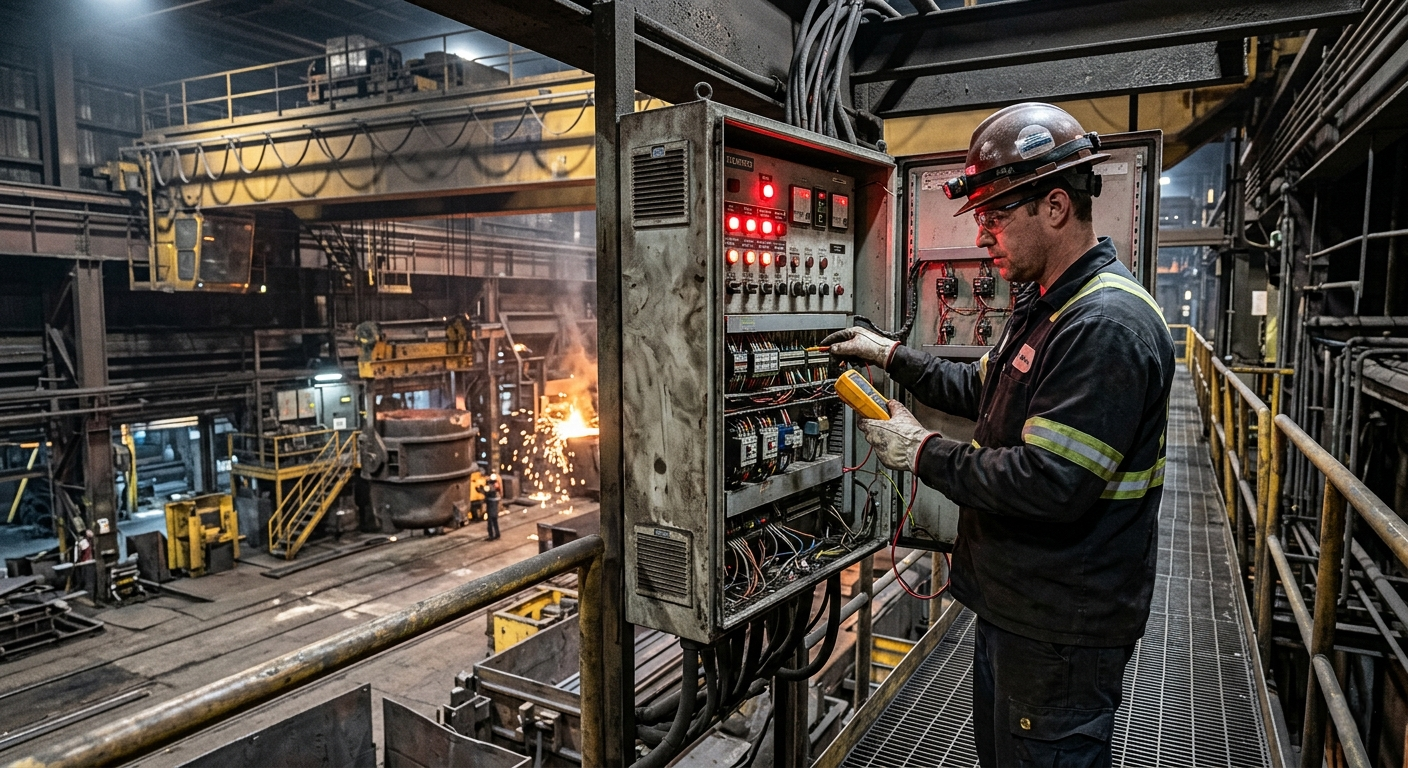
Maintenance technician inspecting a crane controller panel with fault indicators in an industrial plant.
Why Do Crane Controllers Fail? Understanding the Root Causes
Before diving into specific crane controller problems and their solutions, it is important to understand the underlying reasons why crane control equipment fails in the first place. Crane controllers operate in some of the most demanding industrial environments in the world — exposed to extreme heat, heavy vibration, electrical surges, dust, moisture, and continuous mechanical stress. These conditions create a complex set of failure triggers that maintenance teams must be prepared to address proactively.
Primary root causes of crane controller failures:
- Deferred or inadequate preventive maintenance of crane control gear
- Exposure to harsh environmental conditions — extreme heat, humidity, dust, and corrosive atmospheres
- Electrical overloads and power supply irregularities damaging crane control circuits and components
- Normal wear and tear on mechanical crane control components such as limit switches, contactors, and crane brakes
- Improper crane operation placing excessive stress on crane control equipment beyond its rated capacity
- Aging crane control panels and outdated electrical components operating past their designed service life
- Inadequate electrical grounding and shielding leading to interference in PLC-based crane control systems
- Use of incorrect or poor-quality replacement parts that do not meet original crane control equipment specifications
Most Common Crane Controller Problems and How to Fix Them
1. Crane Does Not Start — No Response from Controller
One of the most frequently reported crane controller problems is a complete failure to start when the operator engages the pendant push button station or joystick controller. While this can appear to be a serious fault, it is often caused by relatively straightforward electrical or mechanical issues within the crane control panel that can be resolved with systematic troubleshooting.
Common causes:
- Blown fuses or tripped circuit breakers in the crane control panel
- Faulty or damaged emergency stop circuit — E-stop button stuck in the depressed position or wiring broken
- Broken or disconnected wiring between the pendant push button station and the crane control panel
- Main contactor failure — contactor not energising due to coil burnout or mechanical jamming
- Overload relay tripped due to motor overload, phase failure, or incorrect relay calibration
- Complete power supply failure or phase loss at the crane control panel input terminals
How to fix it:
- Check and reset all circuit breakers; inspect and replace blown fuses in the crane control panel
- Inspect the complete emergency stop circuit — confirm the E-stop button is fully released and circuit continuity is confirmed
- Use a multimeter to check continuity of all pendant push-button station wiring and terminal connections
- Inspect the main contactor coil resistance and mechanical operation; replace the contactor if the coil is burnt or the mechanism is jammed
- Reset the overload relay; measure motor current draw and verify it is within the nameplate rating
- Verify three-phase power supply at the crane control panel input using a calibrated voltmeter
2. Limit Switch Failures — Crane Over-travel or Failure to Stop
Limit switch failures are among the most common and potentially dangerous crane controller problems in industrial crane operations. Rotary limit switches, lever-operated limit switches, and roller limit switches are critical crane control gear components that protect the crane from mechanical overtravel — preventing the hook block, bridge, and trolley from exceeding their safe operational travel limits.
Common causes:
- Mechanical wear on limit switch cams, rollers, and actuating levers from continuous high-frequency crane operation
- Physical misalignment of the limit switch actuator due to vibration, mechanical impact, or structural movement
- Burned or welded contacts inside the limit switch from electrical arcing at the contact assembly
- Ingress of dust, moisture, or industrial contaminants into the limit switch housing degrading contact performance
- Incorrect limit switch calibration — travel limits set too close to or beyond the mechanical crane stop positions
- Broken or loose wiring connections at the limit switch terminal block
How to fix it:
- Inspect limit switch cams, rollers, and actuating levers for visible wear or mechanical damage; replace worn components
- Realign the limit switch actuator to the correct operating position relative to the crane travel mechanism
- Test limit switch contacts using a multimeter; replace limit switches with burned, welded, or pitted contacts
- Clean and properly seal limit switch housings; upgrade to IP65-rated limit switches in dusty or wet crane environments
- Recalibrate travel limit settings with reference to verified mechanical crane stop positions
- Inspect and securely tighten all wiring connections at the limit switch terminal block
3. Crane Brake Problems — Failure to Hold Load or Slow to Release
Crane brake faults are critical crane controller problems that directly impact both operational efficiency and workplace safety. DC electromagnetic brakes and AC solenoid thruster brakes are the primary braking mechanisms used in EOT crane hoist and travel drive systems. When crane brakes malfunction, consequences can range from jerky, uncontrolled crane movement to catastrophic uncontrolled load drops — one of the most serious safety hazards in crane operations.
Common causes:
- Worn brake lining or brake pads — reduced friction surface unable to hold the rated crane load
- Burnt or open-circuit brake electromagnet coil — brake fails to release when power is applied
- Incorrect brake air gap setting — gap too large prevents full brake engagement; gap too small causes brake dragging and overheating
- Oil or grease contamination on brake lining surfaces — significantly reduces available braking friction
- Mechanical wear on thruster brake components — worn push rods, return springs, or pivot pins
- Power supply fault to the crane brake circuit — brake not receiving the correct DC or AC supply voltage
How to fix it:
- Measure brake lining thickness against manufacturer specification; replace brake linings when worn below the minimum allowable thickness
- Test brake electromagnet coil resistance using a multimeter; replace the coil assembly if open circuit or short circuit is detected
- Measure and adjust the brake air gap to the manufacturer’s specified tolerance using calibrated feeler gauges
- Degrease brake friction surfaces thoroughly; investigate and address the source of oil or grease contamination
- Inspect and replace all worn mechanical components in thruster brake assemblies — push rods, springs, and pivot pins
- Verify correct supply voltage at brake terminals; check the rectifier unit in DC electromagnetic brake circuits
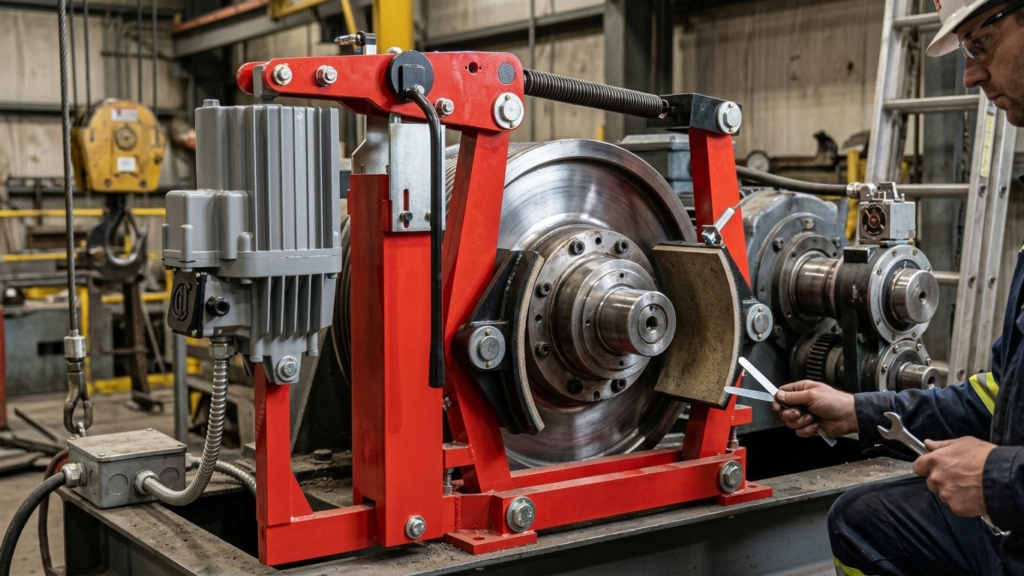
Close-up of EOT crane brake assembly and limit switch being inspected by a maintenance engineer.
4. Pendant Push Button Station Faults — Intermittent or No Control Response
Pendant push button stations are the most operator-facing crane control equipment in daily industrial crane use — and consequently one of the most frequently damaged and worn crane control components. Faults in pendant push button stations can cause intermittent crane control response, unintended crane movements, or complete loss of operator control — all of which present serious operational safety risks.
Common causes:
- Worn or damaged push button contacts from repeated daily operation over extended periods
- Water, oil, or dust ingress into the pendant push button housing in wet or outdoor crane environments
- Damaged or frayed pendant cable — broken conductors causing intermittent signal loss to the crane control panel
- Broken strain relief at the pendant cable entry point — mechanical stress concentrating on conductors at the cable entry
- Loose terminal connections inside the pendant push button station enclosure
- Physical impact damage to the pendant push button station — dropped or struck pendant housings
How to fix it:
- Test individual push button contacts with a continuity tester; replace faulty push button elements with correctly rated replacements
- Inspect and replace pendant station gaskets and environmental seals; upgrade to IP65-rated pendant push button stations in wet or dusty crane environments
- Conduct a full pendant cable inspection for damaged or broken conductors; replace cables that fail continuity or insulation resistance tests
- Install or replace strain relief fittings at the cable entry point to eliminate mechanical stress on conductor connections
- Inspect all internal terminal connections; tighten or re-terminate loose connections using correct ferrules and termination tools
- Replace physically damaged pendant push button enclosures — cracked or broken housings compromise environmental protection and operator safety
5. Joystick Controller and Master Controller Faults
Joystick controllers and master controllers are precision crane control gear components used in cabin-operated overhead cranes, gantry cranes, and heavy-duty industrial crane applications. Faults in these crane control devices result in loss of directional control, speed control irregularities, or complete crane immobilisation — directly compromising operator safety and crane productivity.
Common causes:
- Worn cam contacts and cam profile erosion in master controllers from continuous high-frequency switching operation
- Mechanical wear on joystick controller gimbal mechanism and return spring assembly — joystick fails to self-center
- Contamination of internal joystick or master controller components from dust and lubricant ingress
- Burned or pitted contact surfaces at the master controller cam contact assembly
- Loose or corroded wiring terminal connections at the joystick or master controller connection points
How to fix it:
- Inspect master controller cam contacts for pitting, burning, or excessive wear; replace contact assemblies as required
- Test joystick controller return-to-centre function; replace gimbal mechanism or return springs if the joystick does not self-center correctly after release
- Clean internal components with an appropriate contact cleaner; reseal the enclosure to prevent recurrence of contamination
- Dress or replace burned cam contacts in master controllers — never operate with pitted, welded, or severely worn contacts
- Inspect and tighten all terminal connections; apply corrosion inhibitor compound to terminal blocks in high-humidity environments
6. PLC-Based Crane Control Panel Faults
As crane operations across industries increasingly adopt PLC-based crane control systems, a more technologically complex category of crane controller problems has emerged — faults within the programmable logic controller, input/output modules, and associated electronic control components. PLC crane control panel faults can be more challenging to diagnose than traditional relay-based crane control faults, requiring technical knowledge of both crane electrical systems and PLC programming and diagnostics.
Common causes:
- PLC I/O module failure — input or output channels not responding correctly to sensor signals or operator commands
- Program corruption or loss due to power supply failure or depleted PLC battery backup
- Communication faults between the PLC and HMI panels, remote I/O modules, or VFD drives
- Electrical noise and electromagnetic interference causing erratic PLC operation or false input triggering
- Power supply module failure within the crane control panel — incorrect supply voltage to PLC and control components
- PLC component overheating due to inadequate crane control panel ventilation or panel cooling fan failure
How to fix it:
- Use PLC diagnostic software to identify faulty I/O channels and error codes; replace defective I/O modules with correctly rated replacements
- Check PLC battery backup status; replace the backup battery and restore the crane control program from a verified backup copy
- Inspect all communication cables and connectors between the PLC and connected devices; replace damaged or degraded cables
- Install proper cable shielding, earthing connections, and EMI filters throughout the crane control panel to reduce electrical interference
- Verify all power supply module output voltages against specification; replace failing power supply modules
- Inspect panel cooling fans and ventilation filters; clean or replace to ensure adequate airflow to PLC and drive components
7. Radio Remote Control System Faults
Radio remote control systems for cranes provide operators with the operational freedom to control crane movements from the optimal ground-level vantage point — improving both load handling precision and operator safety by removing personnel from directly beneath suspended loads. However, radio remote control crane faults can cause sudden loss of crane control at critical moments, creating significant safety and operational risks.
Common causes:
- Depleted or faulty transmitter battery — the single most common cause of sudden radio remote control system failure
- Radio frequency interference from other wireless equipment operating on the same frequency band in the facility
- Damaged or obstructed receiver antenna — reducing reliable signal reception range and response speed
- Moisture ingress into the radio remote control transmitter or receiver enclosure degrading electronic components
- Pairing or synchronization loss between the radio remote control transmitter and the crane receiver unit
How to fix it:
- Replace the transmitter battery with a fully charged unit; maintain a rotation of charged backup batteries for all radio remote control transmitters
- Change the operating frequency channel on the radio remote control system if interference from other equipment is detected
- Inspect and reposition the crane receiver antenna for maximum signal coverage across the full crane operating area
- Inspect transmitter and receiver enclosure seals; replace deteriorated gaskets and consider upgrading to IP65-rated radio remote control units in wet environments
- Re-pair the transmitter and receiver unit following the manufacturer’s synchronization procedure
8. Variable Frequency Drive (VFD) Faults in Crane Control Systems
Variable Frequency Drives are increasingly integrated into modern EOT crane control systems to provide smooth, energy-efficient motor speed control — eliminating the mechanical shock of direct-on-line motor starting and enabling precise, stepless crane speed management. VFD faults in crane control panels can cause erratic speed control, motor protection trips, or complete crane immobilization.
Common causes:
- Overheating of VFD power components due to blocked cooling vents, failed cooling fans, or high ambient temperature
- Input power supply irregularities — voltage spikes, phase loss, or harmonic distortion stressing VFD input components
- Incorrect VFD parameter settings not properly matched to the connected crane motor specifications
- Ground fault or insulation failure in the crane motor connected to the VFD output — triggering ground fault protection
- EMI interference affecting VFD control signal integrity and communication with the PLC-based crane control system
How to fix it:
- Clean all VFD cooling vents and heat sink fins; inspect cooling fans and replace failed units immediately
- Install input line reactors and surge protection devices on the VFD input to protect against power supply irregularities
- Review and correct all VFD parameter settings using the original drive commissioning documentation and motor nameplate data
- Test crane motor insulation resistance using a calibrated megger instrument; repair or rewind motors with failed insulation
- Install EMI filters on VFD input and output cables; ensure all drive cables are correctly shielded and earthed
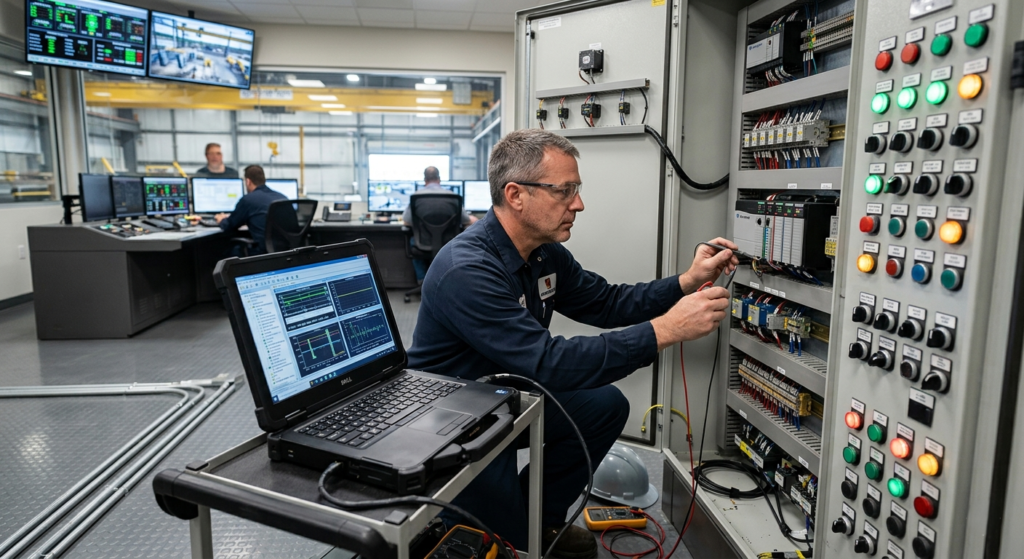
Engineer troubleshooting a PLC-based crane control panel with a diagnostic laptop connected.
Preventive Maintenance: The Most Effective Solution to Crane Controller Problems
While this guide has focused on diagnosing and resolving crane controller problems after they occur, the most cost-effective approach to crane control equipment management is a well-structured preventive maintenance program. Reactive crane maintenance — addressing faults only after they cause operational failures — consistently costs more in unplanned downtime, emergency repair charges, and lost production revenue than a disciplined, scheduled maintenance approach.
Recommended preventive maintenance schedule for crane control equipment:
Daily Checks
- Visual inspection of pendant push button stations and joystick controllers for physical damage or wear
- Functional test of all crane movements — hoist up/down, bridge travel, trolley travel — before the start of each operational shift
- Verification of emergency stop circuit operation from all E-stop locations
- Check radio remote control transmitter battery charge level and confirm reliable signal range
- Listen for unusual noises from crane brakes, motors, gearboxes, or structural components
Monthly Checks
- Inspect and clean all limit switch actuators, cams, and contact assemblies; verify correct travel limit settings
- Check crane brake air gaps using feeler gauges; measure brake lining thickness and compare against minimum specification
- Inspect pendant push button station cables, connectors, and strain reliefs for wear, damage, or insulation deterioration
- Check all crane control panel terminal connections for tightness and signs of corrosion or overheating
- Test and verify overload relay settings against motor nameplate current ratings
- Inspect VFD cooling filters and fans; clean filters and replace failed fans
Annual Checks
- Comprehensive inspection and electrical testing of all crane control gear — limit switches, contactors, relays, control panels, and wiring
- Full crane brake overhaul — replace worn linings, adjust air gaps to specification, and inspect all mechanical brake components
- Megger insulation resistance test of all crane motors to identify developing insulation failures before breakdown
- PLC program backup verification and battery replacement in all PLC-based crane control systems
- Full calibration and functional test of anti-collision devices and load monitoring electronics
- Review, update, and archive all crane control equipment maintenance records and inspection reports
When to Replace vs When to Repair Crane Control Equipment
One of the most important decisions facility managers and maintenance engineers face is whether to repair a faulty crane controller or invest in a full crane control equipment replacement or revamp. While repair is often the most immediate response to a crane controller fault, continued repair of chronically aging crane control gear becomes progressively less cost-effective compared to a planned upgrade.
Clear indicators that crane control equipment replacement or revamping is the better option:
- The crane control panel is more than 15–20 years old and original spare parts are no longer available from the manufacturer
- The same crane controller faults are recurring repeatedly despite repairs — indicating systemic aging of crane control equipment
- Crane downtime due to control equipment failures is significantly impacting production throughput and operational costs
- The existing crane control system cannot support modern safety requirements such as anti-collision devices, load monitoring electronics, or overload protection
- High energy consumption due to outdated motor starting technology — VFD integration can deliver immediate energy efficiency improvements
- The existing relay-based crane control system cannot support IoT connectivity, remote monitoring, or predictive maintenance platforms
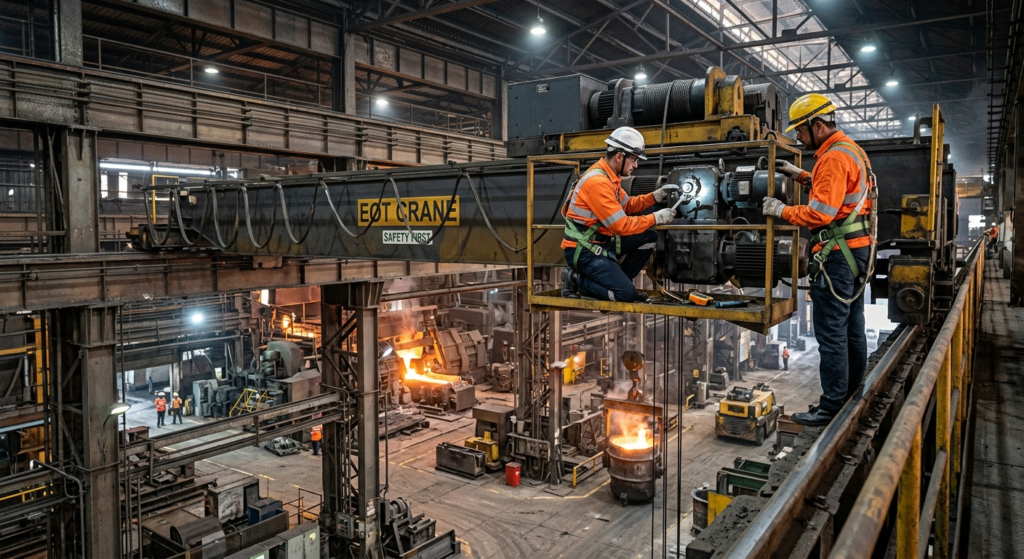
Maintenance team performing annual preventive maintenance on an overhead EOT crane inside a steel plant.
FAQs
1. What are the most common reasons for crane controller failure?
The most common causes of crane controller failure include electrical faults such as blown fuses and contactor failures, limit switch wear and misalignment, crane brake lining deterioration, pendant push button station damage from physical wear or environmental ingress, and power supply irregularities. In PLC-based crane control systems, I/O module failures, program corruption, and electrical interference are also frequent contributors to crane controller problems in modern industrial facilities.
2. How do I know if my crane limit switch needs replacement?
Key indicators that a crane limit switch requires replacement include crane over-travel beyond its normal operating position, failure of the crane to stop correctly at its end-of-travel limit, intermittent or erratic crane stopping behaviour, and visible physical damage to the limit switch housing, actuating lever, or cam mechanism. A continuity test using a multi-meter on the limit switch contacts will confirm whether the contact assembly is functioning correctly within specification.
3. How often should crane brake linings be replaced?
Crane brake lining replacement frequency depends on the crane duty class, operating cycle frequency, and the nature of the industrial environment. As a general guideline, brake lining thickness should be inspected every six months and replaced when worn to 50% of the original specified thickness. In high-duty cycle crane applications — such as steel plant ladle cranes, casting bay cranes, or scrap handling cranes — significantly more frequent inspection intervals are strongly recommended to maintain safety margins.
4. Can crane controller faults be repaired on-site or do they require workshop attention?
Many common crane controller problems — including fuse replacement, contactor cleaning, limit switch adjustment and replacement, pendant push button repair, and crane brake air gap adjustment — can be carried out effectively by qualified on-site maintenance personnel. However, PLC fault diagnosis and programming, VFD repair and recommissioning, crane motor rewinds, and complete crane control panel revamping typically require specialised workshop facilities and certified crane electrical engineers with appropriate diagnostic equipment.
5. How can industrial facilities reduce crane controller problems?
The most effective strategy for reducing crane controller problems is implementing a comprehensive preventive maintenance program covering daily operational checks, monthly crane control gear inspections, and annual full overhauls of all crane control equipment. Using correctly rated, high-quality crane control gear from reputable manufacturers, ensuring adequate environmental protection for all control components, training operators in correct crane operation and early fault reporting, and partnering with experienced crane control specialists all contribute significantly to reducing fault frequency and overall crane maintenance costs.
6. When should a facility upgrade to a PLC-based crane control system?
Upgrading to a PLC-based crane control system is strongly recommended when the existing relay-based crane control panel is experiencing frequent recurring faults; when original spare parts are no longer available; when the operation requires advanced safety features such as anti-collision protection, automated load monitoring, or overload prevention electronics; or when the facility wants to enable remote monitoring, IoT connectivity, predictive maintenance, and data-driven crane performance optimization across its crane fleet.
Key Takeaways
- Crane controller problems — including limit switch failures, brake faults, pendant push button issues, joystick faults, and PLC control panel failures — are among the leading causes of unplanned EOT crane downtime in industrial facilities
- Early identification and timely repair of crane control equipment faults is consistently more cost-effective than emergency breakdown repairs and associated production losses
- A structured preventive maintenance program — covering daily, monthly, and annual inspection intervals — can reduce unplanned crane downtime by 40–50% and extend crane control equipment service life by 30–40%
- Limit switch wear and misalignment, crane brake lining deterioration, and pendant push button station damage are the three most frequently encountered crane controller problems across industrial crane fleets
- PLC-based crane control systems offer superior built-in fault diagnostics, remote monitoring capability, and predictive maintenance integration compared to traditional relay-based crane control panels
- Upgrading aging crane control equipment through professional revamping or replacement becomes more cost-effective than continued repair when recurring faults, parts unavailability, or safety compliance gaps are present
- High-quality, correctly rated crane control gear from established manufacturers significantly reduces fault frequency and extends overall crane control equipment service life
- Radio remote control systems, Variable Frequency Drives, and anti-collision devices require specific maintenance attention — their faults are increasingly common as crane automation adoption accelerates across industrial operations
Conclusion
Crane controller problems are an inevitable reality of industrial crane operations — but they do not have to be a source of costly unplanned downtime, safety incidents, or operational disruption. By understanding the root causes of the most common crane controller faults, equipping your maintenance team with the knowledge and tools to identify and resolve them efficiently, and investing in a structured preventive maintenance program, you can significantly improve the reliability, safety performance, and productivity of your crane operations.
From limit switch failures and crane brake malfunctions to PLC-based control panel faults and radio remote control issues, every crane controller problem has a systematic, practical solution. The key is acting on early warning signs, using correctly specified crane control equipment for your operational environment, and partnering with experienced crane control specialists who understand the specific technical and safety demands of your industry.
Whether your facility requires high-quality replacement crane control gear, expert fault diagnosis and on-site repair services, or a comprehensive crane control system revamp and modernisation, working with a trusted, experienced crane control equipment manufacturer and service partner ensures that your crane operations remain safe, reliable, and productive — shift after shift, year after year.
Speed-O-Controls — trusted for over 40 years as a leading manufacturer and supplier of crane control equipment, EOT crane parts, and industrial control gear across India and global markets. Contact us for expert guidance on manual, automated, or hybrid crane control solutions tailored to your industry.
📧 sales@socgroup.in | 📞 +91-22-42469700 | 🌐 www.speedocontrols.com